

Lockback
Locking folding knives have mechanisms that lock the blade in the open position, activated by opening the blade all the way. A lockback gets its name from a rocker (rocking “lock” bar) partially visible on top of the knife. Opening the blade causes the “rocker” to lock against the blade so it locks open. Pushing down on the rocker on top of the handle releases it and enables the user to close the blade. Lockbacks require two-hand closing, though some are one-hand openers.
Liner Lock
A “Liner Lock” (AKA “locking liner”) is a folding knife that locks open via a tensioned metal liner inside the handle. Similar to a “Lockback” opening the blade activates the lock. Unlocking is achieved by placing the thumb on the front part of the liner and pushing to the left, which releases the blade. Liner locks are typically one-hand open, one-hand close. A blade thumb stud or hole enables one-hand opening.
Frame Lock
A frame lock functions like a liner lock, but the locking mechanism is a section of the handle “frame”-on the side of the knife. The “frame lock” is a channeled lock arm that moves inward to lock against the blade when the knife is opened. Pushing outward releases it from its “locked position” so the user can close the blade. Benefits are fewer moving parts and lighter weight. Frame locks are typically one-hand open, one-hand close.
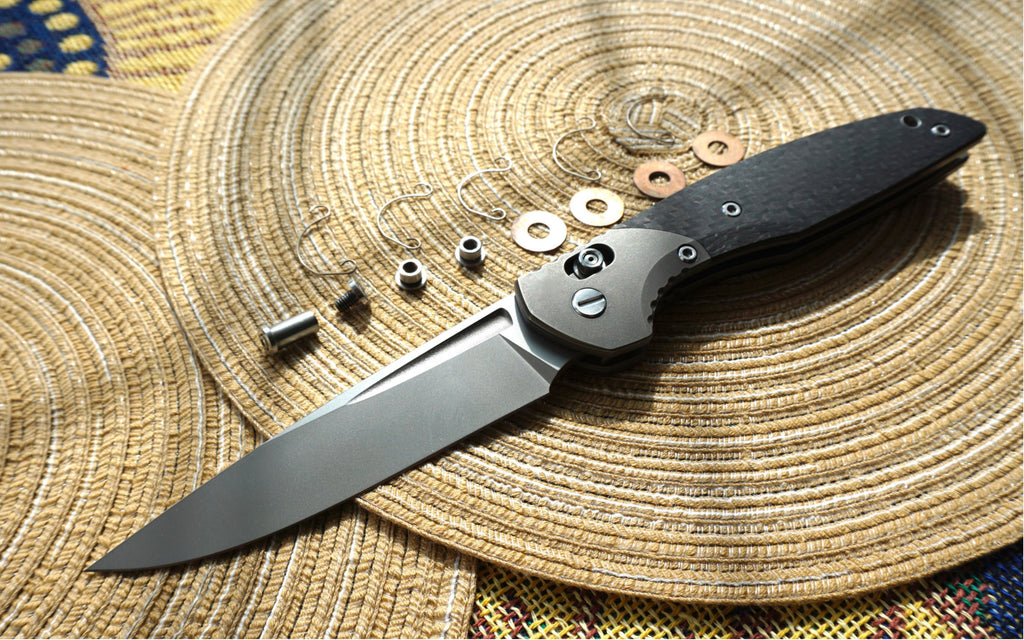
Button Lock
A push-button is usually located near the front of the handle. The push-button acts as a lock in either the closed or open position. Pushing the button unlocks the blade and allows you to open or close it. Button locks may be one-or two-hand open, one-or two-hand close.
Strong Lock System (SLS)
This is a newer locking mechanism and may be referred to as “Strap Lock” by others in the industry. Utilized on our 830 Marksman model, the SLS uses a metal “strap” along the spine of the knife as a lock bar. Using a flipper to engage the blade, the strap lock bar snaps into the blade lock recess at which point the strap and blade are aligned linearly providing a configuration similar to a fixed blade knife. It has proven to be one of the strongest locking mechanisms available. To disengage the blade, simply lift up the strap with your thumb and use your other hand to rotate the blade closed.
Assisted-Opening
With assisted-opening knives, the user initiates the blade opening, after which a mechanism completes the opening. Typically, the user presses on part of the blade, then once the blade has moved past a detent, the assisted-opening mechanism takes over and opens the blade the rest of the way. A safety lock prevents accidental blade opening-the user disengages it prior to blade opening, then re-engages after the blade is closed. Assisted-openers are typically one-hand open/ one-hand close.