

There’s a lot to look for when it comes to picking out your kitchen knife set. Let’s take a look at some of the main criteria.
- Variety
This has to do with what we just discussed. Are you buying a set of steak knives for the next time you have company over for a nice steak? Or are you looking for a well-balanced assortment of kitchen knives that’ll allow you to tackle any culinary task that comes up in your kitchen? Do you need a set that includes kitchen shears? Do you need BBQ equipment? Etc.
There’s no right or wrong answer here, of course. These are things you have to figure out for yourself, as it’s all about what your wants and needs are as a chef.
- Presentation
The question here is: do you want a set of knives you can show off in a nice knife block? Or is that not really a big deal at all? Knife blocks are great because they turn your kitchen knives into a decorative piece for your kitchen. They also make your knives very easy to quickly access; simply slide them out of the knife block instead of rummaging through drawers.
Counter space tends to be a concern when it comes to knife blocks, and it makes sense that it would. If you live in an apartment with a small kitchen, you need to make sure you’re making the most out of every inch of counter space. Thankfully, there are some knife blocks that you can fold up and stow away quite easily.
- Materials
One thing I’ve learned in the time since I’ve become a kitchen knife connoisseur (of sorts) is that there is no single factor more important in the overall quality of a kitchen knife than what it’s made out of. I went from thinking all knives were made of “pretty much the same thing” to scouring the internet looking for information about how different types of steel interact together.
For instance: Carbon steel, a component made from a metal alloy consisting of carbon and steel. Carbon helps to make the steel much stronger and more durable, allowing it to hold its sharp edge for much longer. The only downside is that carbon steel knives are prone to rusting, making them somewhat high-maintenance.
Stainless steel knives are great, and some of the most common ones you’ll find in kitchen knife sets. They sharpen very easily and are a breeze to take care of. But every material has its drawbacks, and stainless steel tends to lose its edge a little easier than others (that’s why it’s important to know how to sharpen your knives).
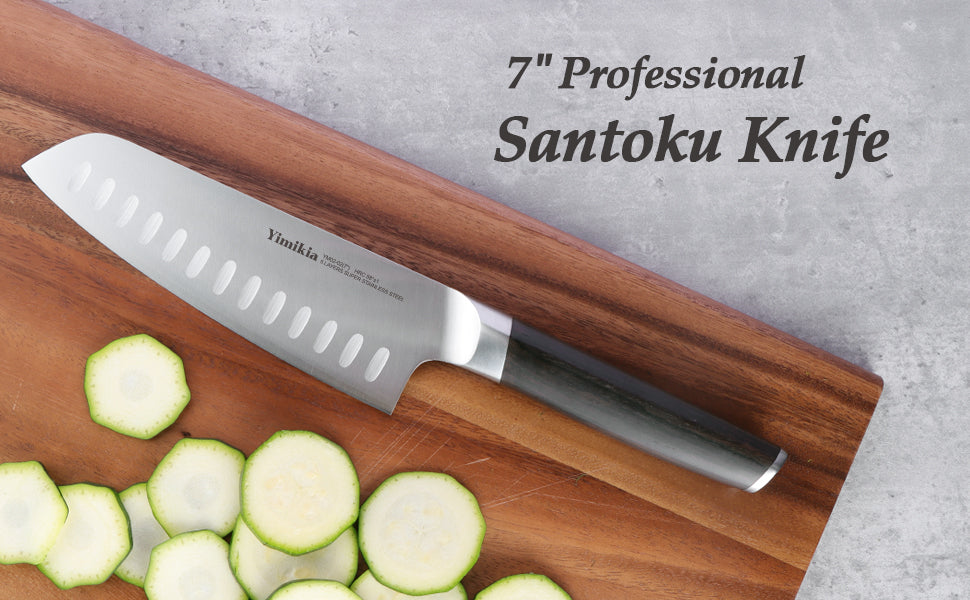
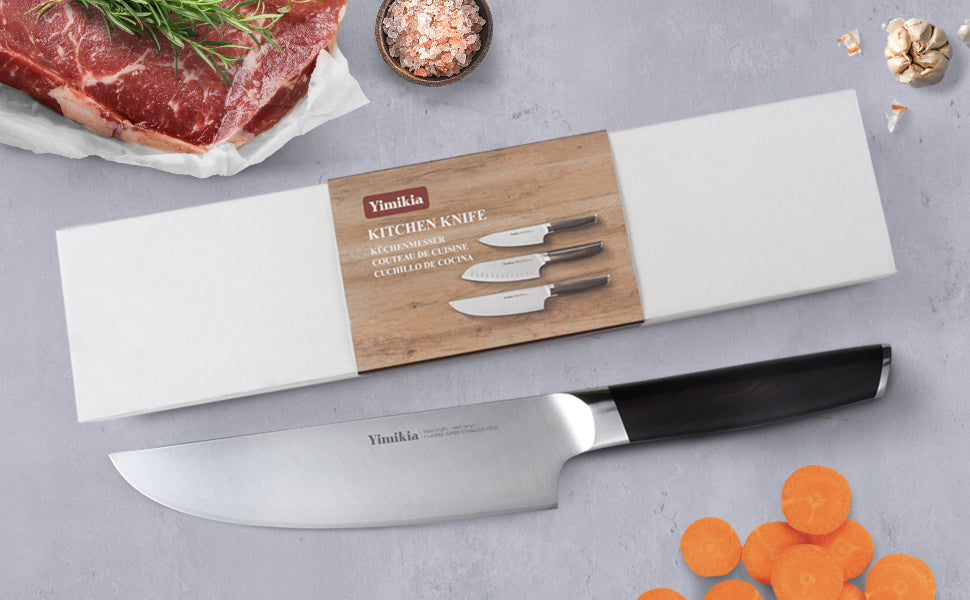
Yimikia steel knives feature a metal alloy that combines the hardness of carbon steel and the flexibility of stainless steel. It has a carbon core with a stainless exterior. Knives that feature Damascus steel tend to be pricier than other materials. So, as you can see, every material has benefits and drawbacks.
- Size
Every kitchen knife type will have a different ideal height. Paring knives, for instance, go anywhere from 3 to 4 inches long, since they’re meant to be used for small, precise cuts. It all depends on their intended tasks.
Chef’s knives, which are multipurpose kitchen powerhouses, tend to hover around the 8” range – they’re meant to work on just about everything. And then there are knives that are designed to break down large pieces of meat, such as a breaking knife, than can be upwards of 14” long. It all depends on the knife and what it’s meant for.
The takeaway here is that if you’re looking for variety, your kitchen knife set should reflect that with a variety of sizes.
- Weight & balance
Kitchen knives that feel like flimsy little nothings are probably towards the lower end of the quality spectrum. A good quality kitchen knife feels substantial without being heavy, uncomfortable, or awkward. Some of the cheaper knives out there are way too light and you just know you’ll be throwing them out within days.
When we talk about balance, we are referring to the weight distribution of the knife. It’s important that there is equal weight distribution between the handle and the blade. If it’s too heavy on the blade, you’ll find it hard and cumbersome to use; if the grip itself is the heaviest part, you won’t be using it at its full potential and you’ll find it uncomfortable.
This is one of those “you’ll know it when you feel it” scenarios, but that’s something you’ll pick up pretty quickly when you start trying kitchen knives.